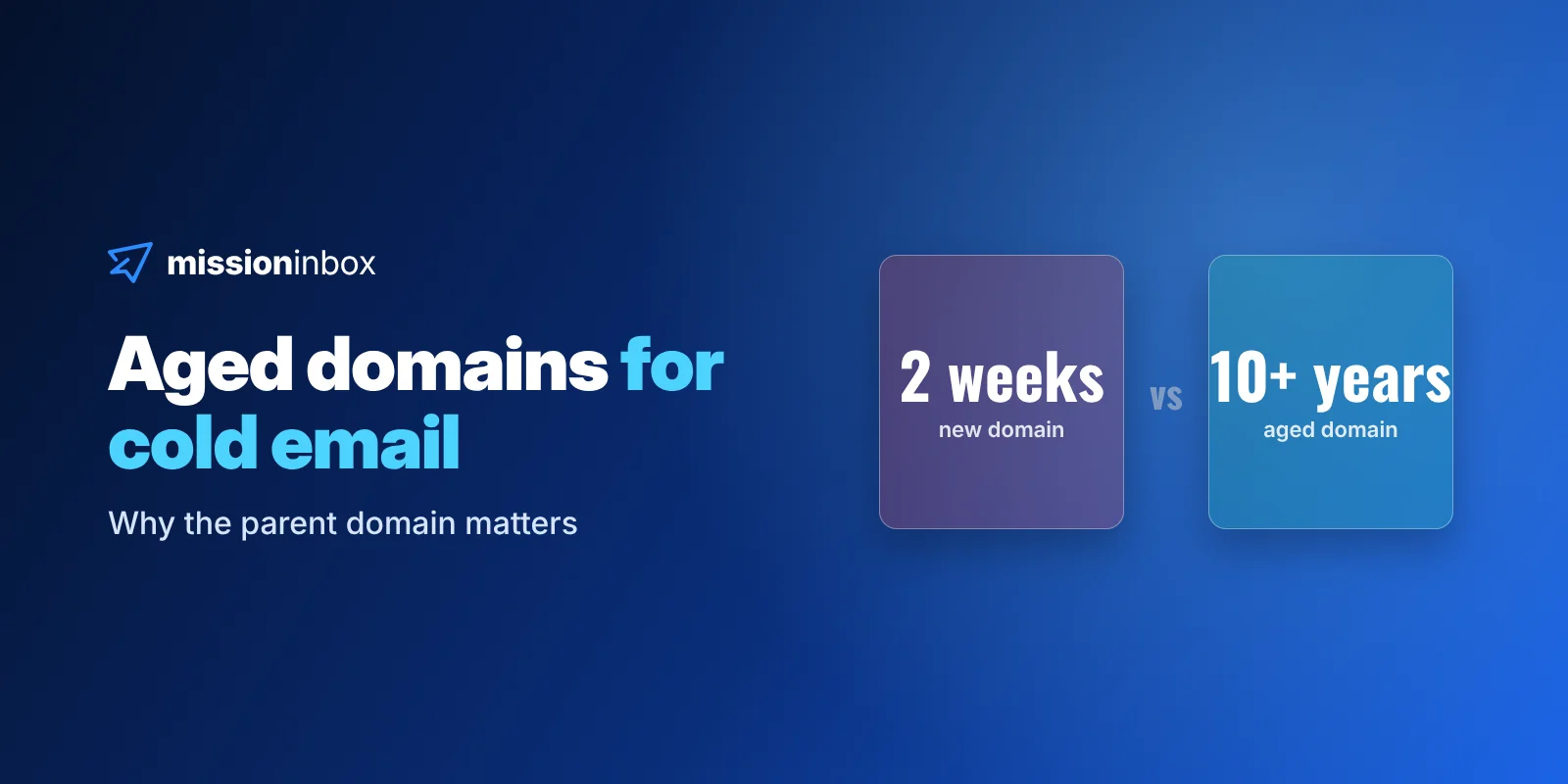
Why the age of the parent domain matters for cold email, and how aged domains compare with newly registered ones.
An aged domain for cold email is a domain that was registered 10 or more years ago, has been renewed every year since and still has a clean reputation. It matters because subdomains inherit the reputation of the domain underneath them. Put 25 subdomains on a domain registered two weeks ago and you multiply nothing. Put them on a domain with a decade of clean history and you multiply trust.
Age isn't the whole house. Your copy matters and your list matters. But age is the foundation, and this guide covers what it is, how to vet it and where people go wrong.
An aged domain has three things going for it at the same time:
Age: registered 10+ years ago.
Continuity: renewed every single year since, never dropped and re-registered by a stranger.
Clean history: no blocklist record, no spam past, a reputation score that shows years of normal behavior.
A five-year-old domain is not "aged" by our definition. Neither is a twenty-year-old domain that spent 2019 sending pharmacy spam. Age without a clean record just means the internet has had more time to learn something bad about it.
Why does domain age matter for cold email?
The way I explain it on calls is a question. Would you trust an email from a domain registered two weeks ago, or from one that's been renewed every year for over a decade?
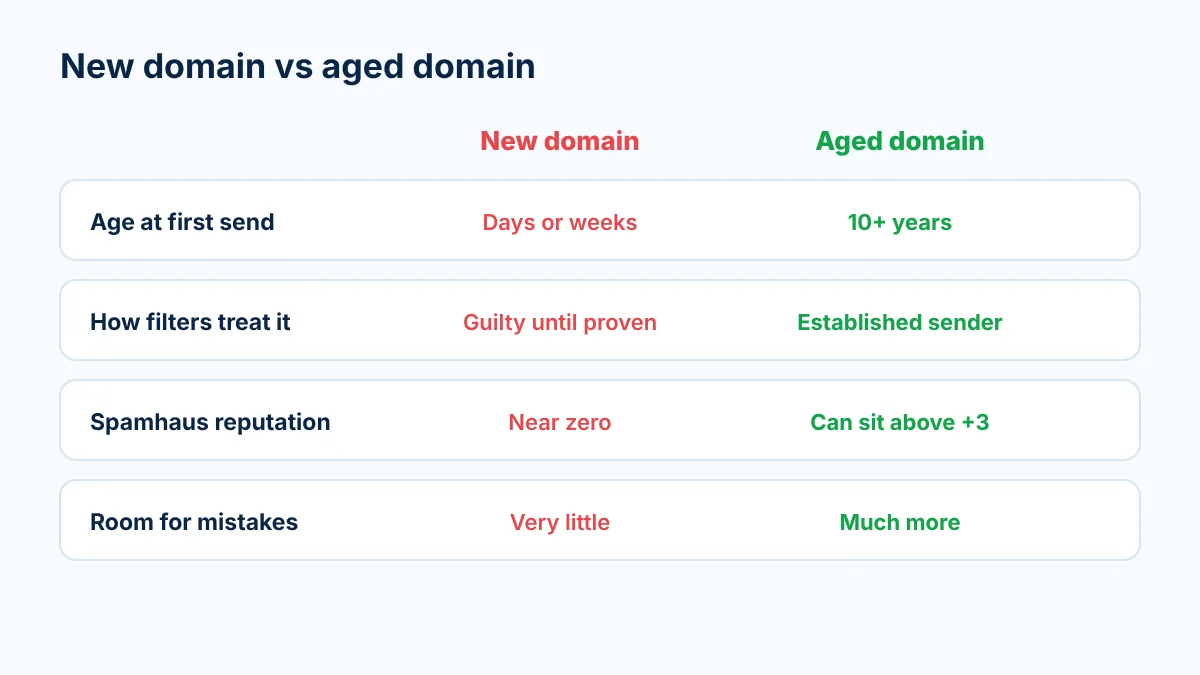
Inbox providers ask the same question, and the reason is simple economics. No spammer waits ten years to send their first cold email. If you're running a spam operation, you buy domains as fast as possible and start sending as fast as possible, because every domain is disposable. So a brand-new domain sending volume on day 20 looks exactly like the thing filters were built to catch.
That's why a new domain is treated as guilty until proven otherwise, and an aged domain is treated as an established sender. Same copy, same list, very different starting point.
How do Google and Microsoft look at domain age?
Neither publishes its exact weights, so this is our read from the sending we see across clients, not an official statement.
In our experience, Google mostly cares about two things: whether your content looks spammy and whether your domain is on a blocklist. Get those right and Google is fairly forgiving with younger domains.
Microsoft plays a different game. It leans heavily on IP reputation and domain age. It's looking for legitimacy. A brand-new domain on a brand-new IP is basically a recipe for failure with Outlook and Microsoft 365. The short version: Outlook reads your domain's birth certificate before it reads a single word of your email.
If most of your buyers sit behind Microsoft 365 or a security gateway, domain age stops being a nice-to-have.
Why do subdomains need an aged root?
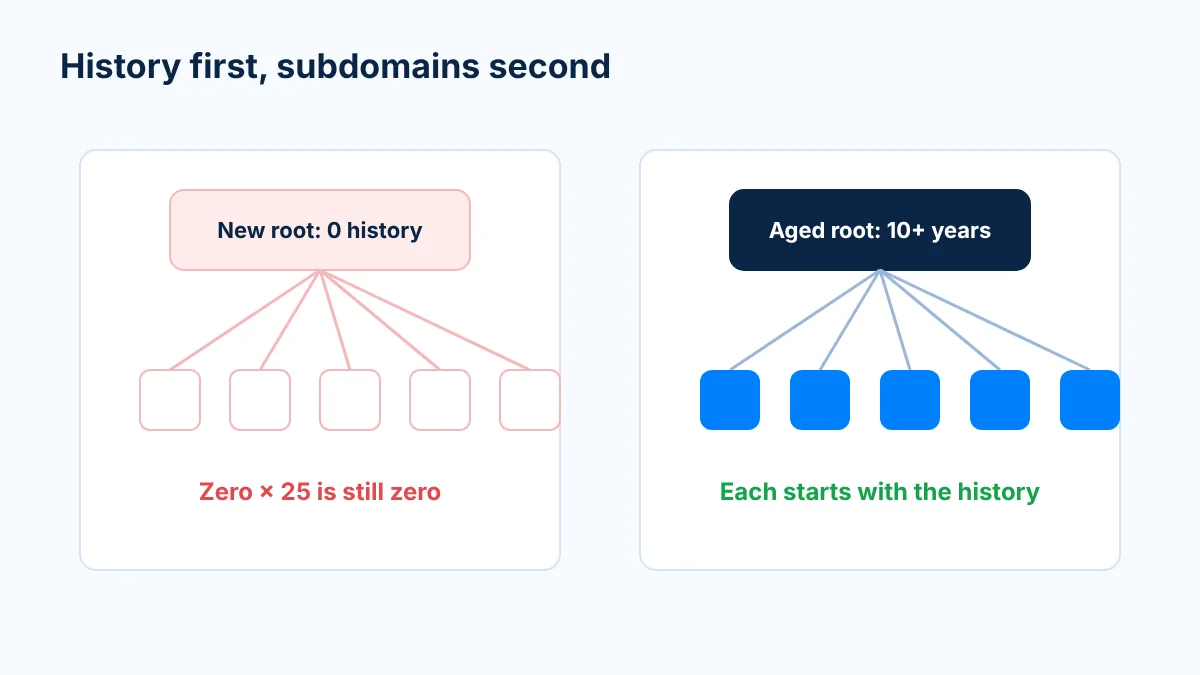
A subdomain inherits the reputation of the domain it sits on. The way I put it: if I'm Zeus and I have a subdomain as a baby, call it Hercules, it's still a baby and I have to nurture it. But it has my reputation, my genetics.
That cuts both ways. A subdomain on a brand-new domain inherits a brand-new domain's history, which is none. Zero history times 25 subdomains is still zero. A brand-new domain is a baby with no parents at all.
Pre-warmed root inboxes can send small volume from day one
New subdomain inboxes
Warm up for 3 weeks on zero history
Warm up for 3 weeks on a decade of history
Room for mistakes
A few complaints can sink it
History buys you room
Is age alone enough?
No, and anyone who tells you an old domain fixes everything is selling something.
The skeptics have a point. Age by itself is a number on a WHOIS record. What inbox providers actually trust is age plus behavior over that time. That's why the Spamhaus domain reputation score is useful: it reflects behavior plus age, and you can't warm up your way into it.
Two more things stay true on an aged domain:
Copy and list still decide replies. Age is the foundation of the house, not the house. A clean old domain sending burned copy to a dirty list will still burn.
New inboxes still need training. Hercules had great genetics and still trained. New inboxes on subdomains of an aged root warm up for about 3 weeks before the first cold email, then ramp from 5 a day, adding 5 a day until they hit about 30. Warm-up keeps running alongside outbound after that. Great genetics, plus a little training.
The flip side is also worth saying out loud: a pre-warmed mailbox on a two-week-old domain is still a two-week-old domain. Warm-up builds the inbox's record. It doesn't change the root's birth certificate.
How do you vet an aged domain before sending from it?
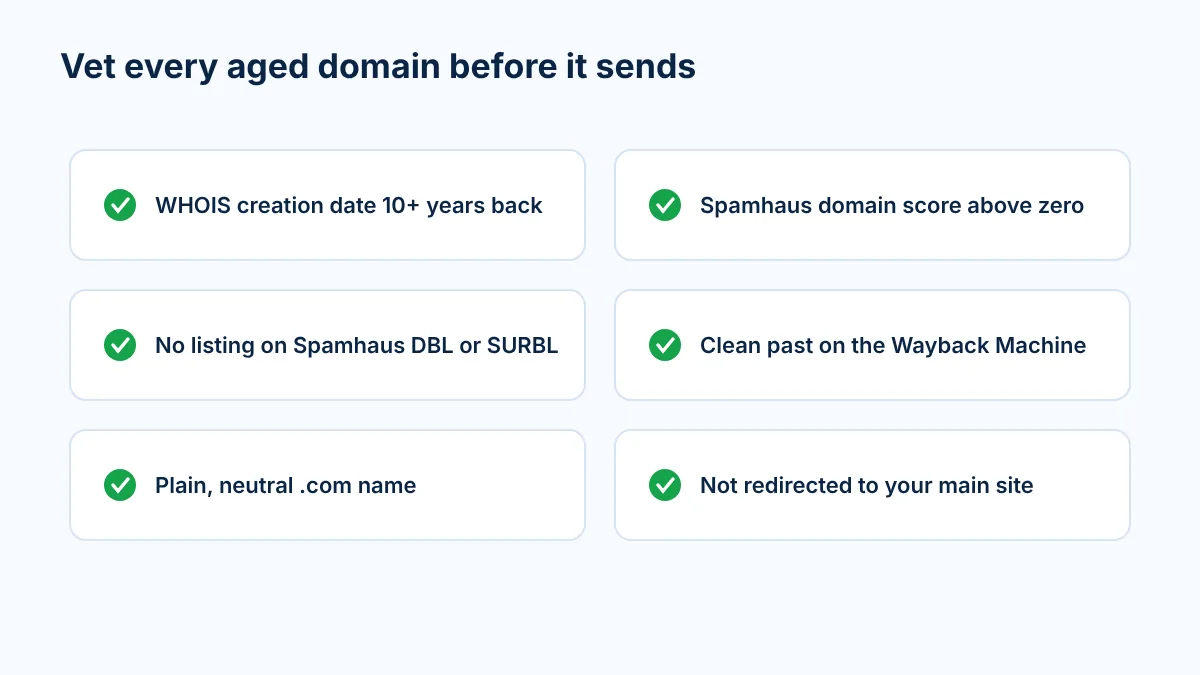
Whether you buy one yourself or lease one, run every candidate through the same checklist.
Check the creation date in WHOIS. Use ICANN's lookup and look for a creation date 10+ years back. If a domain fully expired and was re-registered, the creation date usually resets, so a long continuous date is a good sign it never changed hands through a drop.
Check the Spamhaus domain reputation score. Go to Spamhaus domain reputation and enter the domain. Zero is average. Anything above +3 takes years to build. One domain we looked at, registered in 2005, scored 13.8. That number is behavior plus age.
Check the blocklists. Spamhaus DBL and SURBL list domains, not just IPs, and a listing on the root takes every subdomain with it. Any current listing is a walk-away.
Look at what it used to be. Pull it up on the Wayback Machine. Skip anything with an adult, pharma, gambling or scam past, and anything that looks like a well-known brand's name.
Prefer a plain .com with a neutral name. It should read like a business a real team could work at. No spammy words, no random strings.
Don't redirect it to your main site. Our Deliverability Cheat Sheet covers this as its own principle: at scale, redirected domains get tracked. One client had 25 lookalike domains all redirecting to the same website, the provider that blocklisted them named that as the reason, and removing the redirects fixed deliverability within days. Give the domain its own real page instead.
Never send cold email from the root. The root is the asset you're protecting. Cold email goes out from subdomains on top of it.
If you want the background on reputation scores and how to monitor them, see our guide to checking domain reputation.
Should you use your own domain or a leased aged domain?
There are two paths, and you can decide in about ten seconds.
Path A: your own (or your client's) primary domain. Only if all three are true:
It has years of real outbound sending history, not just years of existing.
Its Spamhaus domain reputation is above +3.
The owner says yes. Agencies with enterprise clients should ask the client first.
If all three check out, you build subdomains on that domain and never send from the root itself. This is the path that fits regulated industries, where firms are expected to send from their real domain. We've set this up for teams in finance and fraud prevention, including Unit21, without touching the root.
Path B: lease an aged domain in Mission Inbox. If any of the three is a no, you pick an aged, non-branded domain inside Mission Inbox:
10+ years old, renewed every year, clean reputation.
5 pre-warmed inboxes on the root that can send about 150 a day from day one, while your subdomains warm up.
Up to 25 subdomains with 3 inboxes each, about 2,250 emails a day per domain once they're ramped.
Only you use it for as long as you lease it.
Subdomains, inboxes and DNS are created the same day and pushed into your sequencer.
It's almost a lookalike domain, but with 10 to 20+ years of history behind it. If you're worried that a non-branded domain hurts replies, we answer that in subdomains vs lookalike domains.
Why not just buy an aged domain at auction yourself?
You can. Expiring-domain auctions are public and anyone can bid. Here's what that looks like in practice:
You bid, and a good chunk of the time somebody outbids you.
When you win, you wait days for the transfer.
Then it's about a month to set up DNS, create inboxes and warm everything up before a real campaign goes out.
Every check in the vetting list above is on you, for every candidate.
If you have the time, the checklist above is exactly what we'd tell you to run. Most teams we talk to would rather spend that month sending. You can't buy time. You can buy a domain that already has it.
What happened when GTMx moved to subdomains on a domain with history
GTMx sells into finance teams, and a lot of their buyers sit behind Barracuda, Microsoft and Google filters at the same time. They had tried several infrastructure providers and their reply rate was under 0.5%.
Their primary domain had a strong reputation, so they took Path A: subdomains built on that domain, cold email never sent from the root. Reply rate went from under 0.5% to above 5%, sending 2,000 to 4,000 emails a day across subdomains, and months later they still hadn't burned a domain.
Joshua Solomon, GTMx's founder, put the age argument better than I usually do:
"When Tony asked me which email I'd trust more, one from a domain registered two weeks ago or one from a domain registered ten years ago, it immediately clicked for me."
And on the result: "Deliverability recovered almost immediately." The full story is in the GTMx case study.
FAQ
What is an aged domain in cold email?
An aged domain is a domain registered 10 or more years ago, renewed every year since, with a clean reputation. Inbox providers have years of history on it, so mail from it starts from trust instead of suspicion.
How old does a domain need to be to count as aged?
We use 10+ years of continuous registration. Younger domains can still be fine senders, but the gap between a two-week-old domain and a ten-year-old one is what inbox providers notice.
Do aged domains still need warm-up?
Yes. New inboxes on subdomains of an aged domain still warm up for about 3 weeks, then ramp from 5 to 30 emails a day. The aged root gives them great genetics. Warm-up is the training.
How do I check a domain's age and reputation?
Look up the creation date in WHOIS (lookup.icann.org), then check the Spamhaus domain reputation score. Zero is average and anything above +3 takes years to build. Also check blocklists like Spamhaus DBL and SURBL.
Can I use my company's own domain instead of an aged domain?
Only if it has years of real outbound sending history, a Spamhaus score above +3 and the owner's approval. Even then, never send cold email from the root itself. Send from subdomains on top of it.
Do subdomains inherit the domain's age?
Filters judge the registered root domain's age and history, so a new subdomain on an aged root starts with that history behind it. The subdomain's own sending record still has to be built through warm-up.
Get the full playbook
Everything in this post, plus the math, the naming list and the four-step fix for when a subdomain burns, is in The Subdomains on Aged Domains Playbook. It's free, and it's the same playbook we run for our clients.
Hopefully in your inbox, Tony
Share article
Read Time
9 MIN READ
Category
Infrastructure
Send with Protection
Stop relying on shared infrastructure that you don't control. Mission Inbox gives you dedicated servers, dedicated IPs, and full ownership of your sending reputation.
How old does a domain need to be to count as aged?
Do aged domains still need warm-up?
How do I check a domain's age and reputation?
Can I use my company's own domain instead of an aged domain?
Do subdomains inherit the domain's age?
Send at volume with Mission Inbox
Stop relying on shared infrastructure that you don't control. Mission Inbox gives you dedicated servers, dedicated IPs, and full ownership of your sending reputation.
Thank you! Your submission has been received!
Oops! Something went wrong while submitting the form.
Before you go
Get a free deliverability consulting call
Grab 30 minutes with our deliverability team. We'll audit your domains, mailboxes and sending volume live, and show you exactly where your placement is leaking. No pitch, no obligation, no card.
See how much pipeline shared infrastructure is making you lose
Spot burned domains and bad IP neighbors before they tank a campaign
See the campaign performance differences between Mission Inbox senders and other providers