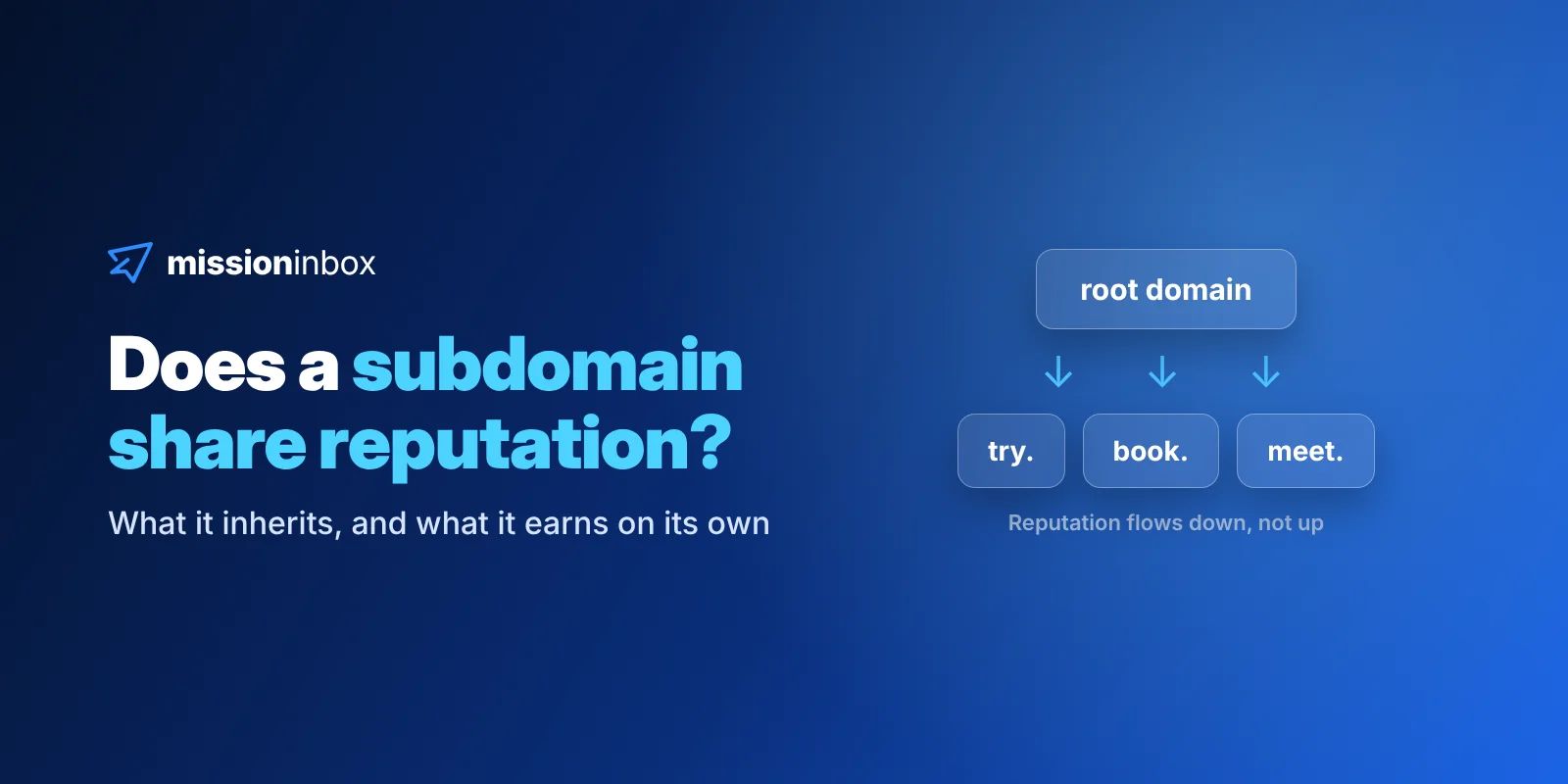
How reputation moves between a root domain and its subdomains, and what a subdomain has to earn on its own.
Yes, a subdomain and its main domain are connected, and that's the point. Reputation flows down: a subdomain inherits the age and history of the root it sits on. What each subdomain does after that, its complaints, replies and placement, is judged largely on its own record by mailbox providers. But the connection runs both ways in a few specific places: domain blocklists list the root, and Google counts bulk volume at the primary domain.
So the honest answer to "will a subdomain hurt my main domain?" is: it can, if the main domain is your brand and you run it carelessly. That's why we never build cold email on a brand domain. We build it on an aged domain that exists only to be a strong, protected parent, and that never sends a cold email itself.
This page walks through what the people who set the rules actually say, what's inherited and what's earned, where the risk really sits, and how to check it. For the full strategy, see our complete guide to subdomains for cold email.
Last updated: November 2026
Why do so many people say "never use subdomains for cold email"?
Because they're picturing the wrong setup.
The common advice goes like this: you send cold email from outreach.yourcompany.com, it gets complaints, and now yourcompany.com, the domain your CEO, your invoices and your customers use, takes the hit. That fear is reasonable. If your root is your brand, anything that climbs back up lands on your business.
The advice gets one thing right and one thing wrong. Right: you should never put your brand domain at risk for cold email. Wrong: the fix is to throw away subdomains and buy dozens of brand-new lookalike domains with no history. That trades one risk for another, because new domains are exactly what spam filters trust least.
There's a third option almost nobody talks about. Keep the subdomains, change the root. Put them on an aged domain that is not your brand.
What do Google, Spamhaus, Microsoft and the industry actually say?
Before getting into how we run it, here's what the primary sources say. No vendor blogs, just the rule-makers.
Source
What it says
What it means for cold email
Google (Gmail sender FAQ)
Bulk volume is counted across the whole primary domain, subdomains included. Alignment is checked at the organizational domain.
25 subdomains on one root are one sender to Gmail. Keep per-inbox volume normal.
Spamhaus DBL
Lists at the main domain level. Every subdomain of a listed domain returns "listed".
If the root is listed, every subdomain goes with it. The root must be clean and protected.
SURBL
Subdomains of a blacklisted domain match the listing.
Same as above, for links and domains in the email body.
M3AAWG (industry best practice)
Use subdomains of your organizational domain. They benefit from its existing reputation. Unknown reputation is "similar to bad". Warm new subdomains anyway.
Inheritance is real and useful. A subdomain on an established root beats a domain with no history, but it still needs warm-up.
Microsoft (Outlook.com sender support)
Filters weigh IP, domain, authentication, list accuracy, complaints and content. New IPs under an existing domain inherit some of its reputation. No published rule on subdomains.
Treat everything under one root as related. Don't count on Microsoft treating a subdomain as a stranger.
A few things stand out.
Google is explicit that it rolls subdomains up for volume. Its sender FAQ says "messages sent from the same primary domain count toward the 5,000 limit," with the example of 2,500 emails from solarmora.com plus 2,500 from promotions.solarmora.com making you a bulk sender. Google's DMARC alignment check also works at the organizational domain level.
Blocklists act on the root. Spamhaus says in its DBL FAQ that "DBL lists at the main domain level, and all hostnames and subdomains of that domain also return a 'listed' result." SURBL's guidelines say the same: "subdomains of a blacklisted domain will match a blacklisted domain."
The industry body recommends subdomains, because of inheritance. M3AAWG's Sending Domains Best Common Practices says "proper use of subdomains will help your sending program benefit from the organizational domain's existing reputation." It also says a domain with no history "usually starts as unknown, which makes it similar to bad." Its updated Sender Best Common Practices (August 2026) adds that "when sending from a new subdomain, to be safe, domain warming is recommended even if the organizational level domain already has an established reputation."
Microsoft doesn't publish a subdomain rule. We looked for the statement people quote, that Microsoft says subdomain reputation "bleeds over" to the primary domain, and couldn't find it in any Microsoft documentation. What Microsoft does say, on its Outlook.com sender support page, is that its filters are "influenced by a number of factors related to the sending IP, domain, authentication, list accuracy, complaint rates, content and more," and that new IPs authenticated under an existing domain's SPF "typically experience the added benefit of inheriting some of the domain's sending reputation." In other words, Microsoft treats related things as related. So do we.
Put together, the sources agree on two things. History flows down, and that's good. And a few signals are counted at the root, so the root has to be protected.
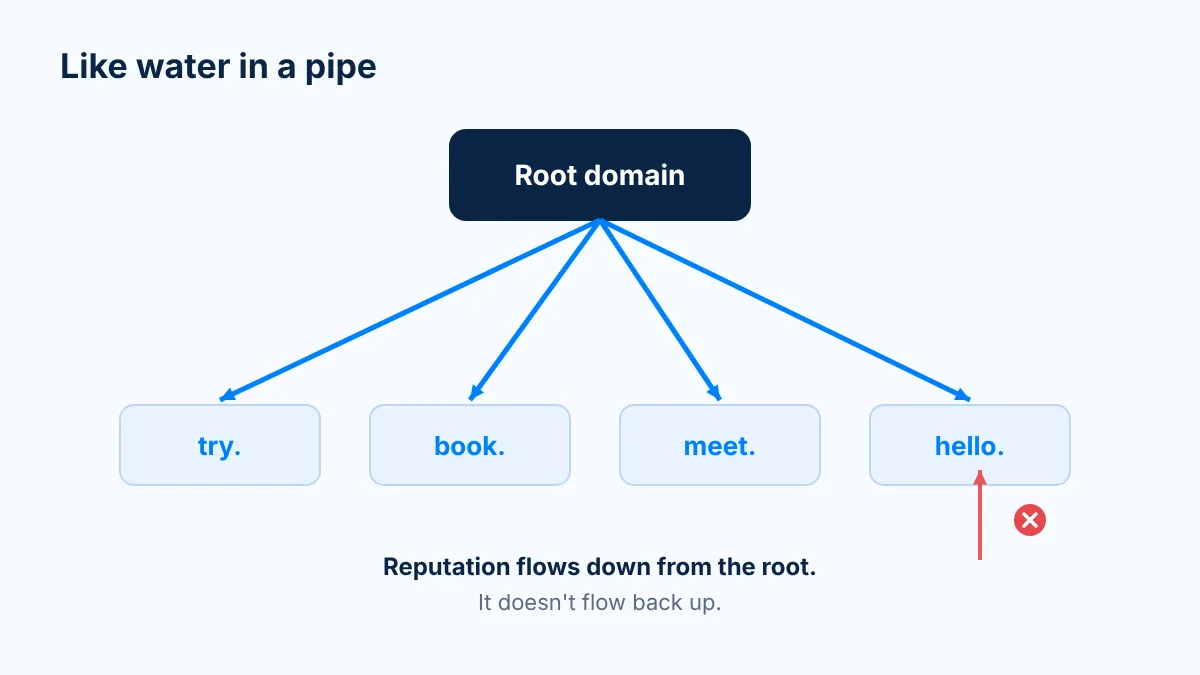
Reputation flows down, not up
The way I explain it on calls: reputation works like water in a pipe. It flows downwards from the root to every subdomain. It doesn't suddenly flow back up because one subdomain had a bad week. Subdomains don't go against the laws of physics.
That's why a new subdomain on a 15-year-old domain behaves nothing like a brand-new domain. Think of Zeus and Hercules. If the root is Zeus, the subdomain is Hercules: still a baby, still needs training, but born with great genetics. A brand-new lookalike domain is a baby with no parents at all. And if you send a baby to war, it dies.
But "not up" needs an honest asterisk, because there are two ways damage can reach the root:
Blocklists. If a subdomain is abused badly enough that Spamhaus or SURBL lists the registered domain, every subdomain under it is listed too. The listing doesn't care which subdomain caused it.
Volume counted at the root. Google adds up all subdomains for its bulk-sender threshold. If you ignore that and blast from 25 subdomains with no care for complaints, you are one sender to Gmail, not 25.
Neither of those is a reason to avoid subdomains. They're the reason the root must be aged, clean, never used to send cold, and run with conservative volume per inbox.
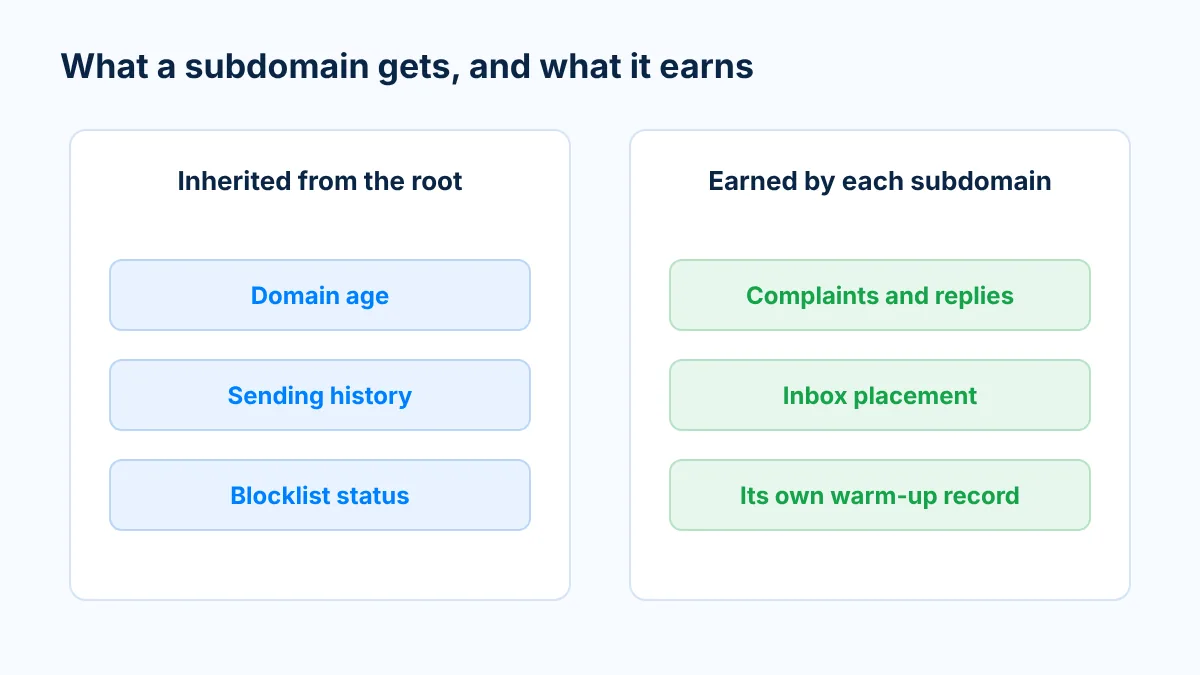
What does a subdomain inherit, and what does it earn on its own?
This is the distinction that makes the whole thing click.
Inherited from the root
Earned by each subdomain
Age
The root's registration date and years of renewals
Nothing, a subdomain has no birthday of its own
History
The root's sending history and standing with blocklists
Its own inboxes' warm-up and sending record
Complaints and replies
No
Yes, recorded against what that subdomain sends
Inbox placement
A head start
Decided largely by its own behavior, name and volume
Blocklist listings
Yes, a listed root lists every subdomain
Bad enough abuse can get the root listed
Gmail bulk count
Counted together at the root
Adds to the root's total
Inherited history is the head start. Earned reputation is what you do with it. That's why every new subdomain inbox still warms for about 3 weeks before its first cold email, then ramps from 5 a day up to a normal ~30. Great genetics, plus a little training.
The setup that keeps your brand out of it
Here's how we run subdomains at Mission Inbox, and why each rule exists.
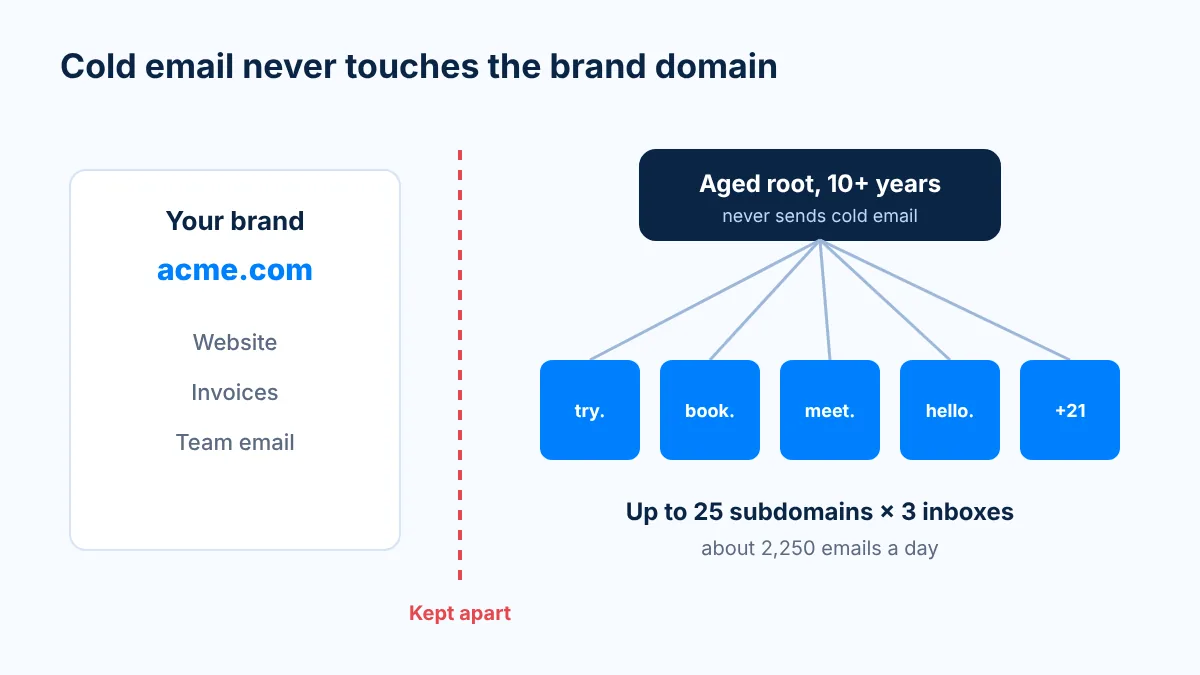
The root is an aged domain, not your brand. Registered 10+ years ago, renewed every year since, clean reputation. If anything ever climbs back up, it climbs into a domain that exists only for sending, not into the domain your customers and invoices use.
The root never sends cold email. Only the subdomains do. The root's job is to be the parent.
Up to 25 subdomains, 3 inboxes each, about 30 emails a day per inbox. That's about 2,250 a day per aged domain. Need more? Add another aged domain, don't push harder on one.
One campaign per subdomain (one client per subdomain for agencies). A bad list burns only its own subdomain.
Retire fast. If one subdomain slips, it gets stopped, its records deleted and a fresh one created. It's a DNS record, so it costs nothing. We cover the four-step routine in how to set up, name and warm up subdomains.
This is what turns the "shared reputation" objection on its head. On a brand domain, inheritance is a risk. On an aged sending domain, inheritance is the asset you're paying for. Why that root has to be aged, and what "aged" really means, is in aged domains for cold email.
Can you use subdomains on your own company domain?
Sometimes, and when it works, it works very well. GTMx, a fintech client, ran subdomains on its client's own primary domain, which had years of strong history. Reply rate went from under 0.5% to above 5%, and months later no domain had burned. As Joshua Solomon, GTMx's founder, put it: "Deliverability recovered almost immediately." You can read the full GTMx case study.
Our rule is strict, though. Use your own root only if all three are true:
It has years of outbound sending history, not just years of existing.
Its Spamhaus domain reputation score is above +3.
The owner says yes. Agencies, ask your client first.
If any of the three is a no, use subdomains on a separate aged domain instead.
How do you check a domain's reputation?
Start with the root, since everything inherits from it.
Spamhaus domain reputation. Go to https://www.spamhaus.org/domain-reputation/?domain=yourdomain.com. Zero is average. Anything above +3 takes years to build. One domain we checked, registered in 2005, scored 13.8. That number is behavior plus age, and you can't warm-up your way into it.
Blocklists. Confirm the root isn't on the Spamhaus DBL or SURBL. Because both list at the domain level, a clean root means clean subdomains on that front.
Postmaster data. Google Postmaster Tools and Microsoft SNDS show what the mailbox providers see over time.
Then check the subdomains, because that's where earned reputation shows up.
How to read reputation per subdomain
Subdomains on the same root don't perform the same, and that's the best evidence that each one earns its own record.
In one placement test we ran for a client, 30 mailboxes were spread across 16 subdomains of the same root, on the same sending IP, with the same copy. Google Workspace seeds inboxed 149 of 150. At Microsoft, the subdomains split: the ones named "hub", "join" and "meet" landed 0% in the inbox, across mailboxes created months apart, while their siblings on the same root landed. Same parent, same server, same email, different result. The difference was the subdomain. (Warm-up mattered too: mailboxes with warm-up on inboxed 20 of 20 at Microsoft, while those with it off inboxed 17 of 40.)
To see this in your own data:
Tag inboxes by subdomain in your sequencer so you can read reply rate per subdomain, not just per campaign.
Compare siblings on the same list and copy. If one subdomain's reply rate drops while the others hold, the problem is that subdomain, not your offer.
Run placement tests by subdomain. If one shows up in spam and its siblings don't, retire it.
Watch where bounces and blocks cluster. If they bunch up on one subdomain's inboxes, that's your burn.
When one goes, the fix is boring on purpose: stop sending from it, delete its records, create a new subdomain, warm it 3 weeks and ramp it back up. On a one-domain setup, a burn is a crisis. On subdomains, it's a Tuesday.
FAQ
Does a subdomain share reputation with the main domain?
Partly. A subdomain inherits the root's age and history, and mailbox providers judge most of what it does after that on its own record. But domain blocklists like Spamhaus DBL and SURBL list at the root, and Google counts bulk volume at the primary domain, so the two are never fully separate.
Can a burned subdomain hurt my main domain?
One subdomain landing in spam usually stays with that subdomain. The real risk is abuse bad enough to get the registered domain itself blocklisted, which hits every subdomain. That is why the root should be an aged domain that is not your brand and never sends cold email.
Do subdomains inherit the domain's age?
Yes. A subdomain sits under a domain that was registered on a specific date, so it starts with that history instead of zero. It still needs about 3 weeks of warm-up before sending, because its own inboxes have no sending record yet.
Does Microsoft say subdomain reputation bleeds into the main domain?
We could not find a Microsoft document that says that. Microsoft says its filters weigh the sending IP, the domain, authentication, list accuracy and complaint rates. Treat subdomains and their root as connected, which is how we run them anyway.
How do I check my domain's reputation?
Look the root domain up on Spamhaus's domain reputation checker. Zero is average and anything above +3 takes years to build. Also confirm the domain isn't on Spamhaus DBL or SURBL, and track reply rate per subdomain in your sequencer.
Should I send cold email from subdomains of my company domain?
Only if your company domain has years of outbound sending history, a Spamhaus score above +3 and the owner's approval. Otherwise use subdomains on a separate aged domain so your brand domain is never exposed.
The bottom line
Subdomains and their root are connected. That isn't a reason to avoid them, it's the reason they work: a subdomain on a 10+ year old domain starts life trusted, and a lookalike bought last week doesn't. Protect the root, never send cold from it, keep each subdomain's volume normal and retire the ones that slip.
Stop relying on shared infrastructure that you don't control. Mission Inbox gives you dedicated servers, dedicated IPs, and full ownership of your sending reputation.
Does a subdomain share reputation with the main domain?
Can a burned subdomain hurt my main domain?
Do subdomains inherit the domain's age?
Does Microsoft say subdomain reputation bleeds into the main domain?
How do I check my domain's reputation?
Should I send cold email from subdomains of my company domain?
Send at volume with Mission Inbox
Stop relying on shared infrastructure that you don't control. Mission Inbox gives you dedicated servers, dedicated IPs, and full ownership of your sending reputation.
Thank you! Your submission has been received!
Oops! Something went wrong while submitting the form.
Before you go
Get a free deliverability consulting call
Grab 30 minutes with our deliverability team. We'll audit your domains, mailboxes and sending volume live, and show you exactly where your placement is leaking. No pitch, no obligation, no card.
See how much pipeline shared infrastructure is making you lose
Spot burned domains and bad IP neighbors before they tank a campaign
See the campaign performance differences between Mission Inbox senders and other providers